
 En
En  Укр
Укр 

This website was created with support of ITC 'Eastern Partnership: Ready to Trade - an EU4Business initiative' project funded by the EU as part of EU4Business Initiative. Read more: https://eu4business.eu



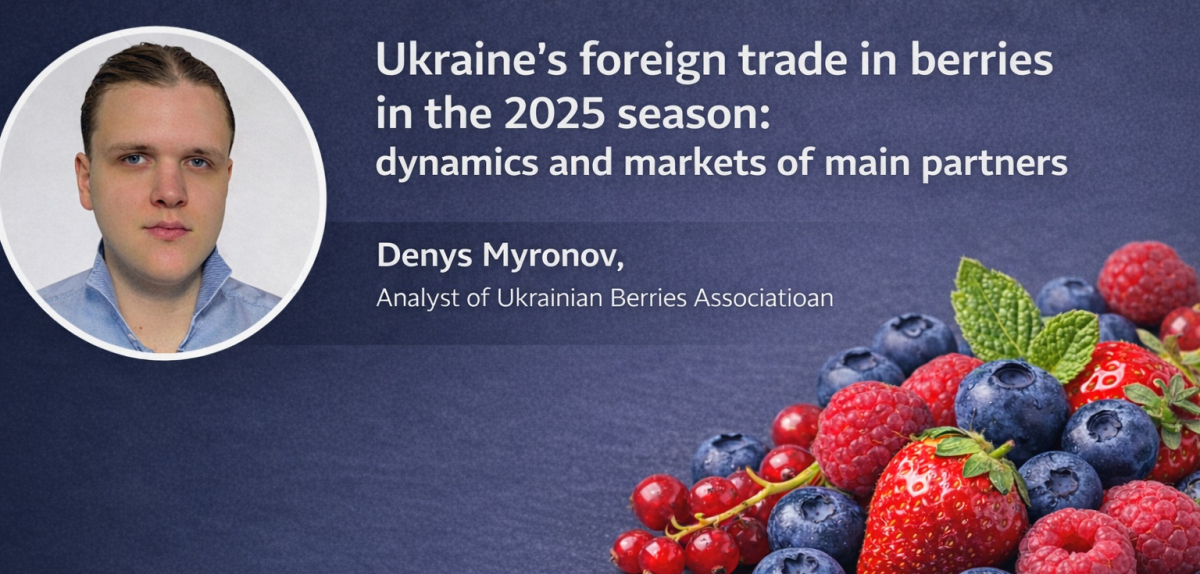
2025 has been marked by significant shifts in Ukraine’s berry foreign trade. The key factor was adverse weather conditions throughout the season. In particular, three waves of spring frosts negatively affected crop formation, especially in open-field production. Additional pressure came from heavy summer rains with hail, which led to partial crop losses and quality deterioration in certain regions. As a result, the market saw reduced supply, shifts in harvest timing, and uneven yield recovery — all of which directly impacted the volume and structure of trade flows.
Denys Myronov, analyst at the Ukrainian Berries Association, analyzed the dynamics of Ukraine’s berry imports and exports in 2025, focusing on actual changes in volumes and trade directions. A separate section of the analysis is dedicated to Ukraine’s key trading partners — Poland and Germany — which generate the core demand for Ukrainian berries and significantly influence market conditions.
Ukraine
Raspberry exports at the start of the season fell by half; fresh raspberries were barely supplied.
Strawberries covered domestic demand only in June; imports increased by 1.5 times.
Frozen currants: exports dropped nearly fivefold.
Blueberries: fresh segment remained stable, while frozen volumes declined sharply.
Poland
Purchases of Ukrainian raspberries increased to the level of 2022.
Blueberries: gradual replacement of Ukrainian supply with Canadian origin.
Ukrainian raspberries help cover shortages and are often re-exported.
July blueberry imports were weak due to lower Ukrainian volumes.
Germany
Reduced supplies from Ukraine pushed raspberry prices higher.
Serbia failed to compensate for the deficit, leaving the market supply-constrained.
Blueberries: the gap left by Ukraine was not filled by Morocco or Peru.
The market shows high sensitivity to seasonal fluctuations in Ukrainian supply.
The full analytical report on Ukraine’s berry foreign trade in the 2025 season, including detailed export volume charts, is available on our website via the link.

Mytropolyta A. Sheptytskoho Str. 4, BC KOMOD, of. 49, Kyiv, 02002, Ukraine