
 En
En  Укр
Укр 


This website was created with support of ITC 'Eastern Partnership: Ready to Trade - an EU4Business initiative' project funded by the EU as part of EU4Business Initiative. Read more: https://eu4business.eu



Shift in Seasonal Dynamics and Decline in Volumes
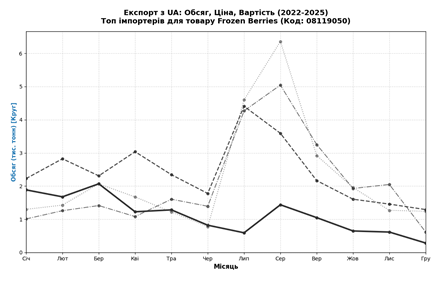
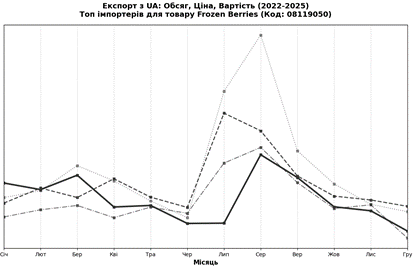
The scale of the harvest decline is most evident in the traditionally active months of July and August. In July 2024, exports reached 4.4 thousand tons, whereas in 2025 this figure dropped to 0.59 thousand tons. August exports also decreased by more than half (from 3.59 to 1.43 thousand tons).
Overall, annual export volumes fell by more than 50%: from nearly 29 thousand tons in 2024 to approximately 13.5 thousand tons in 2025. As a result, instead of the usual summer peak, the market operated under conditions of pronounced supply shortages.
Partial Compensation of Financial Losses Through Price Growth
The shortage of raw materials led to a significant increase in prices. While in 2024 the average price ranged between EUR 2.0–3.2/kg, in the second half of 2025 it rose steadily, reaching EUR 6.31/kg in September and EUR 6.83/kg in December.
This price dynamic partially offset financial losses. Despite a reduction in export volumes of more than 50%, export revenues declined by only 23% — from EUR 73.8 million in 2024 to EUR 56.9 million in 2025. Thus, higher prices helped compensate for lost production volumes.
Distribution of Export Markets for Frozen Blueberries
In 2025, export volumes of Ukrainian frozen blueberries decreased by more than half compared to 2024. This decline, combined with rising prices, significantly reshaped the structure of European markets.
Sharp decline: Germany proved to be the most sensitive to price increases. Export volumes dropped nearly fourfold — from 4.17 to 1.17 thousand tons. As a result, Germany’s share fell from 14.35% to 8.61%.
Stable demand: In contrast, Italy and Austria showed strong resilience. Exports to Italy declined only slightly (from 3.74 to 2.85 thousand tons), increasing its share from 12.89% to 20.99%. In value terms, exports even grew to EUR 10.11 million. A similar trend was observed in Austria: despite a drop in volumes (from 2.70 to 1.69 thousand tons), export revenues increased from EUR 6.25 to 7.32 million.
Proportional decline: Poland and the Czech Republic reduced imports in line with the overall export decline. Poland decreased imports from 7.35 to 3.48 thousand tons, maintaining a stable market share of around 25%. The Czech Republic reduced imports from 5.00 to 2.21 thousand tons (16.26% share by volume), while its share in export value increased to 20.66% (EUR 11.77 million).
These developments illustrate varying tolerance among European partners to price shocks. Germany reduced purchases, while importers in Italy and Austria accepted higher prices to secure supply, becoming key drivers of export revenues amid product shortages.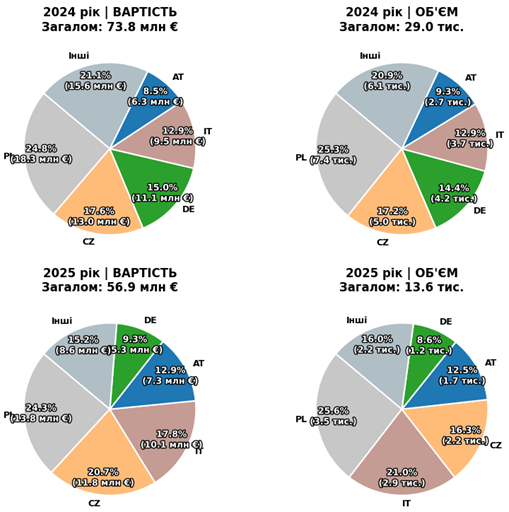
Retrospective Analysis of Frozen Raspberry Exports (2025)
General Trends: Volumes, Value, and Pricing Dynamics
During the period under review, Ukrainian frozen raspberry exports demonstrated steady growth. The key trend of 2025 was a significant increase in export revenues, far outpacing growth in physical volumes.
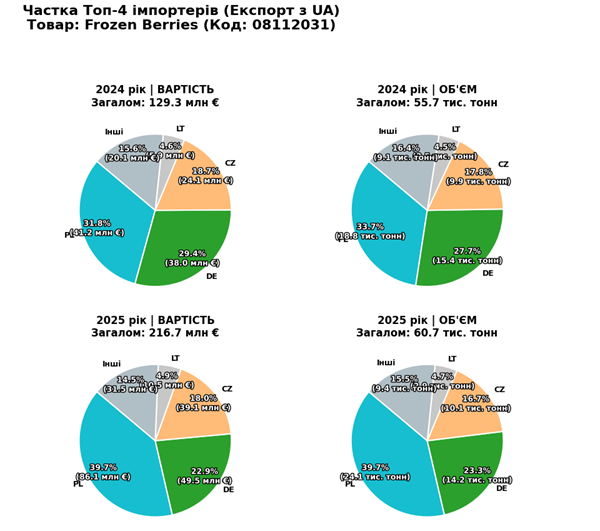
Total export volume increased from 55.7 thousand tons in 2024 to 60.7 thousand tons in 2025 (approximately +9%). At the same time, total export value rose from EUR 129.3 million to EUR 216.7 million, representing an increase of over 67%. This gap is explained by favorable pricing conditions on international markets.
Export Price Dynamics
The main driver of profitability growth in 2025 was the increase in average prices. In 2024, prices rose gradually from EUR 1.72/kg in January to EUR 2.80/kg in December. This trend continued in 2025: the year started at EUR 2.78/kg, and in the second half prices exceeded EUR 3.8/kg, reaching a peak of EUR 4.29/kg in December.
Shift in Peak Months
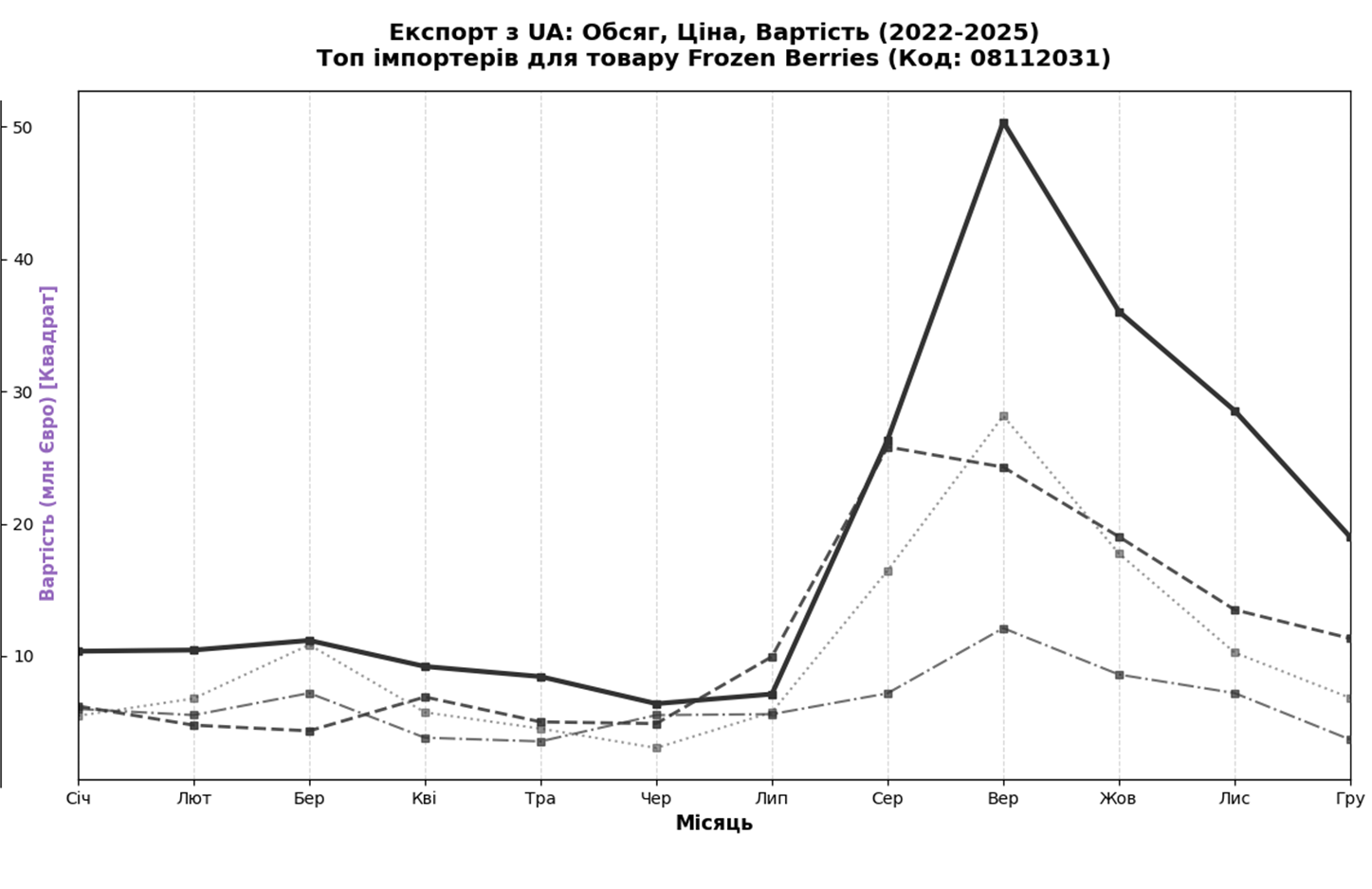
In 2024, the highest export volume was recorded in August (11 thousand tons), generating EUR 25.2 million. In 2025, the peak shifted to September (13 thousand tons). Thanks to a high average price (EUR 3.82/kg), September exports generated EUR 49.8 million — nearly a quarter of total annual revenue.
More Even Supply Distribution
In the first half of 2025 (January–May), monthly export volumes slightly exceeded those of the same period in 2024. This may indicate improved sales planning and more efficient use of storage capacities.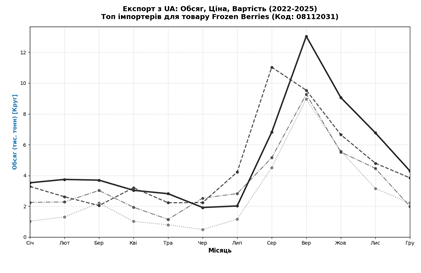
Distribution of Export Markets for Frozen Raspberries
Growing share of Poland: Poland strengthened its position as Ukraine’s key trading partner in this segment, increasing its share in both volume and value:
These figures confirm Poland’s role as a major hub, importing Ukrainian raspberries for both domestic processing and re-export to other EU countries.
Decline in direct exports to Germany:
Germany, the second-largest market, showed a decrease in direct imports:
This trend suggests that part of Germany’s demand is increasingly being met via Polish intermediaries.
Czech Republic as a re-export hub:
The Czech Republic maintained its third position. Its share in export value remained stable (18.6% in 2024 and 18.0% in 2025). Physical volumes stayed nearly unchanged (around 10 thousand tons), while import value increased from EUR 24.1 million to EUR 39.1 million due to rising prices.

Mytropolyta A. Sheptytskoho Str. 4, BC KOMOD, of. 49, Kyiv, 02002, Ukraine